


Technically Restored / 2019-2025
The Sole Survivor: A Brockhouse Trailer Reborn
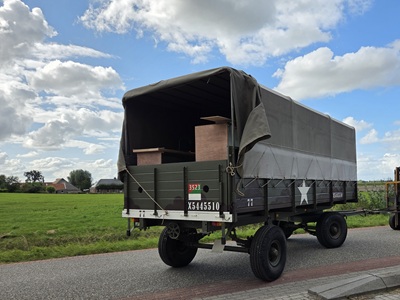
The story of this Brockhouse 5-ton GS trailer begins not in a workshop, but in quiet obscurity—standing forgotten on a farm in Belgium, its purpose long faded, its structure burdened by time and improvisation. At first glance, it was just another relic. But beneath the wear lay a remarkably honest foundation: a steel frame assembled from components stamped with the names of British steel plants, each marking a small testament to its wartime origin. That was enough to justify the effort—not just to restore it, but to understand it. As far as our information reaches, this is the only surviving trailer of its kind in existence. Of the many hundreds once built, all that remains today is this single example—and a handful of photographs. That knowledge gave the project a weight far beyond restoration; it became preservation of something almost lost entirely.
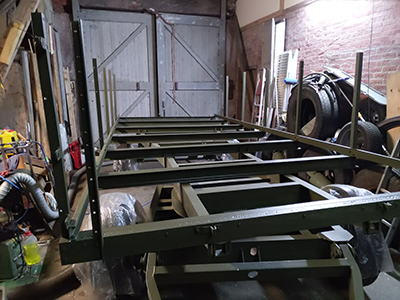
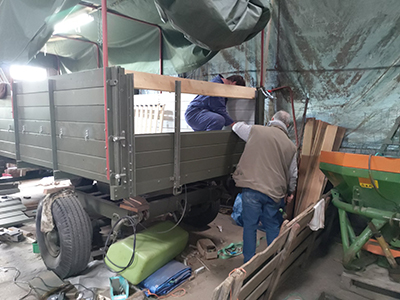
The process began with a complete strip-down. Everything came off until only the bare frame remained. Along the way, a post-war addition — a crooked makeshift storage frame — was removed, peeling back a later chapter of its life. Once exposed, the entire chassis was sandblasted, revealing clean steel and long-hidden details. From there, it was carefully repainted, restoring both protection and presence. With the frame renewed, attention turned to the body. The original wooden side planks had survived the decades surprisingly well, and preserving them became a priority. Each board was restored, retaining its character and subtle signs of service. The front and rear boards, however, had deteriorated beyond saving and were replaced with newly crafted pieces, made to match the original specifications as closely as possible.
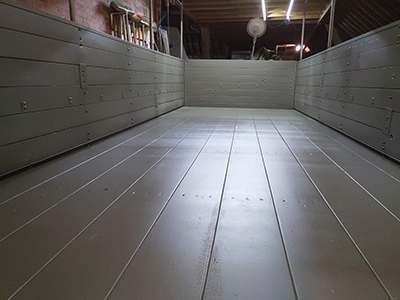
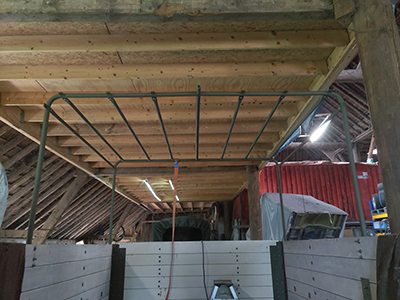
The floor told a different story—it was completely gone. Using reference material and careful measurement, an entirely new floor was reconstructed, bringing the trailer’s structure back to completeness. One of the more challenging elements was the missing roof. Both the metal frame and canvas had disappeared over time. Rebuilding it required a different kind of work: studying a handful of surviving photographs, interpreting angles and proportions, and translating those into a faithful reconstruction. Piece by piece, the silhouette of the trailer returned. Mechanically, the trailer was brought back to life with equal care. The braking system — including the wheel-operated hand brake at the rear — was fully restored and made functional again. What had once been seized and silent could now operate as intended, reconnecting the trailer with its original engineering purpose.
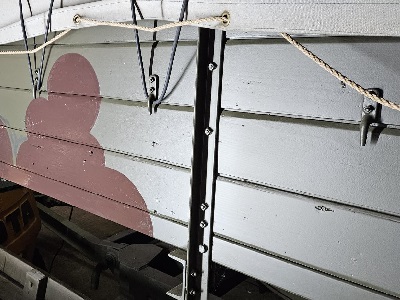
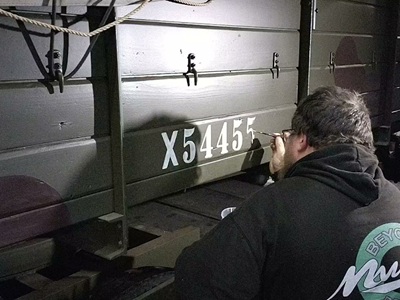
Then came the details that truly define its identity. This was the first major project to have entirely hand-painted details, and that decision shaped the entire finish. The distinctive “Mickey Mouse” camouflage on the right-hand side was meticulously copied from an original black-and-white photograph—every curve and contrast carefully interpreted. On the left-hand side, another photograph provided partial guidance, allowing the pattern to be extended with historical grounding rather than random guesswork. Markings were chosen with equal care. The Arms of Service insignia of a Royal Army Service Corps divisional supply company was applied, reflecting the trailer’s likely wartime role. During this phase, a small but fascinating discovery emerged. A yellow, hand-painted weight class plate on the wood initially appeared correct—but closer inspection revealed it had been overpainted. By carefully removing the top layer, the original marking came to light: a weight class plate from a Matilda tank. A quiet reminder of how materials were reused and repurposed, even during the war.
The lighting told another story. Originally, the trailer had no conventional rear lights. Instead, the rear beam was painted bright white, allowing it to be seen by following vehicles during blackout conditions. This feature was faithfully restored, along with a small white plate mounted on the rear axle, illuminated by a subtle light — an original blackout marker brought back to life. To meet modern road regulations, rear lights were added. A small post-war license plate frame — once an addition — was retained and reused to carry a licence plate, bridging past and present in a practical way.
The trailer’s history did not end with the war. It continued in service with the British Army of the Rhine until 1966, where it was repurposed for a Signals company. From supply duties in wartime to communication support in peace, it remained useful long after its original role had passed. Today, the trailer stands not as a perfect replica of a single moment in time, but as a carefully restored survivor of many. Every preserved plank, reconstructed section, and hand-painted marking reflects a decision—to honor its origins, acknowledge its evolution, and carry forward something that very nearly disappeared forever. What was once left to decay in a Belgian field now speaks again — in steel, wood, and paint — telling the story not just of a trailer, but of the last of its kind.
Specifications
| Brand | Brockhouse |
| Type | 5T GS (General Service) |
| Country | United Kingdom |
| Year | July 1943 |
| No. Built | ~300 (?) |
| Mass | – kg (- lbs) |
| Length | – cm (- in) |
| Width | – cm (- in) |
| Height | – cm (- in) |
| Engine | N/A |
| Transmission | N/A |
| Suspension | Leaf spring, 2×4 |
| Fuel Capacity | N/A |
| Operational Range | Unlimited |
| Maximum Speed | N/A |
| Vehicle number | X5445510 (Trailer No. 77) |
| Appearance & Decals | Mickey Mouse camouflage, AoS: RASC divisional supply company (3523) |